> For the complete documentation index, see [llms.txt](https://wyzebee.gitbook.io/wyzebee/llms.txt). Markdown versions of documentation pages are available by appending `.md` to page URLs; this page is available as [Markdown](https://wyzebee.gitbook.io/wyzebee/coinbase-wallet/set-up-your-wallet.md).
# Set up your wallet
When you initiate a subscription, we ask you to provide the public address of your Bitcoin or other crypto wallet. Your wallet address is unique and only you are able to access it.
If you don't have a wallet when starting a subscription, it is also possible to check "I'll provide my Bitcoin wallet later" and register it before the end of the first active month. Don't worry, adding your wallet after starting a subscription is easy! [Here's how to do it.](/wyzebee/getting-started/what-if-i-selected-to-provide-my-bitcoin-wallet-later.md)\
\
If you need a reliable wallet for your phone, we recommend [Coinbase ](https://wyzebee.com/#mobile)[wallet](https://wyzebee.com/#mobile), one of the most trusted & secure crypto wallets for your mobile phone.
Coinbase Wallet is one of the most secure non-custodian wallets on the market. Designed to safeguard popular cryptocurrencies like [Bitcoin](https://tokeninsight.com/tokenDetail?cid=2365), [Ether](https://tokeninsight.com/tokenDetail?cid=2657), [Ripple](https://tokeninsight.com/tokenDetail?cid=3177), [Tezos](https://tokeninsight.com/tokenDetail?cid=3332), [Litecoin](https://tokeninsight.com/tokenDetail?cid=2906) and many more. The wallet is built and backed by Coinbase, one of the worlds' foremost cryptocurrency exchanges, making it safer and more secure.
{% hint style="info" %}
#### Custodial vs. non-custodial wallets
In order to use digital assets e.g. Bitcoin, a wallet is the first thing you need. Not only is a wallet required to store your coins, but also to perform any transfer of funds. All wallets uses pairs of keys: **public keys**, which are public and used for identification, and **private keys**, which are used for authentication and encryption, and as such need to stay private.
**A custodial wallet** is a wallet in which your private keys are stored by a third party. This means, you do not have full control over your funds, which exposes these wallets to risk, as the third party might get hacked or fail as a business.
**Non-custodial wallets,** on the other hand, allow you to fully control your funds and therefore are more secure. You are responsible for keeping your password and recovery phrase secure because any truly noncustodial wallet will not store this information. Non-custodial wallets may be web, paper, mobile, desktop, and hardware wallets — as is the case with custodial ones.
{% endhint %}
{% hint style="warning" %}
**Please note**
Do not confuse [Coinbase Wallet](https://wallet.coinbase.com/) with [Coinbase Exchange](https://www.coinbase.com/) — they are **not the same.**
You can link your Coinbase Wallet to your Coinbase Exchange account. Although both Coinbase Wallet and Coinbase Exchange offer the ability to store major digital assets like Bitcoin, Ether, Ripple, Tezos, Litecoin and others, the way they store it is different: Coinbase Wallet is a non-custodial wallet solution, while Coinbase Exchange is an exchange service with a built-in custodial wallet.
{% endhint %}
### Step 1: Download & Install
Coinbase Wallet is available on the following links for Android and iOS devices:\
\
**Android:**\
[Coinbase Wallet — Crypto Wallet & DApp Browser](https://play.google.com/store/apps/details?id=org.toshi)\
\
**iOS:**\
[Coinbase Wallet on the App Store](https://apps.apple.com/app/coinbase-wallet/id1278383455?ls=1)
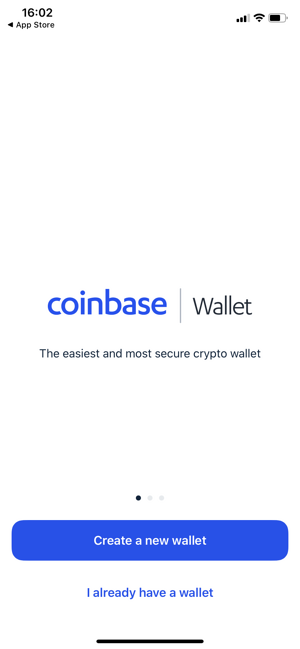
Once you have installed the Coinbase Wallet app on your mobile device you will see the Welcome screen, with the Two options - **Create а new Wallet** and **I already have a wallet**.
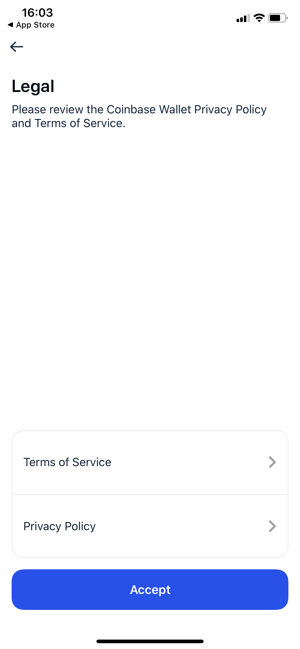
Choose to **Create a new wallet.** You will need to go through the Legal pages and accept the terms and conditions.
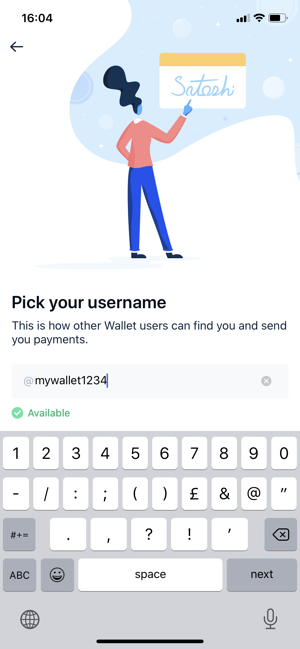
The next step is to choose a **username** for your wallet. This can help you in the future to send Bitcoin and other digital assets between Coinbase Wallet users only by using usernames.
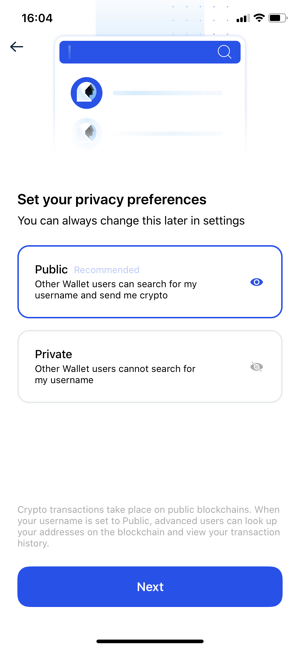
Once you choose the username, you should choose **privacy preferences.** Choose the **Public** if you want your username to be visible by other users, or **Private** if you wish to disable this feature.
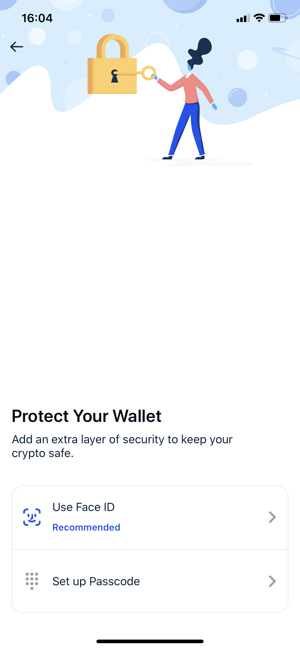
On the next screen, you will be asked to choose how you would like to **protect your wallet**. You can choose from passcode and your device protection service - FaceID, Fingerprint, etc. We recommend to set up both.
Next, you will be prompted to **backup your wallet with a secret recovery passphrase.** This will give you access to your wallet, in the event your hardware (the mobile phone where you installed your wallet) is lost or stolen. You should never share this recovery phrase with anyone else. Basically treat it like the PIN code on your ATM card.

{% hint style="warning" %}
Save the recovery phrase by writing it on a piece of paper that you store somewhere safely, or save it in your password manager.
{% endhint %}
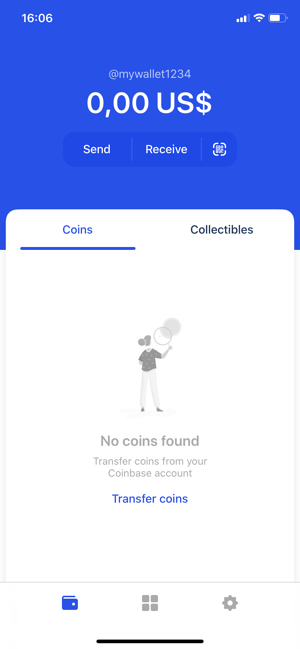
On the next screen, you will see the user dashboard also called the **portfolio**. You will have buttons to send and receive funds, and scan QR codes. The total balance of the wallet will also be shown on top of the screen.